Author Archives: sandra dipasqua

Unknown's avatar

About sandra dipasqua

graphic designer

Celebrating Mystic St. Francis of Assisi

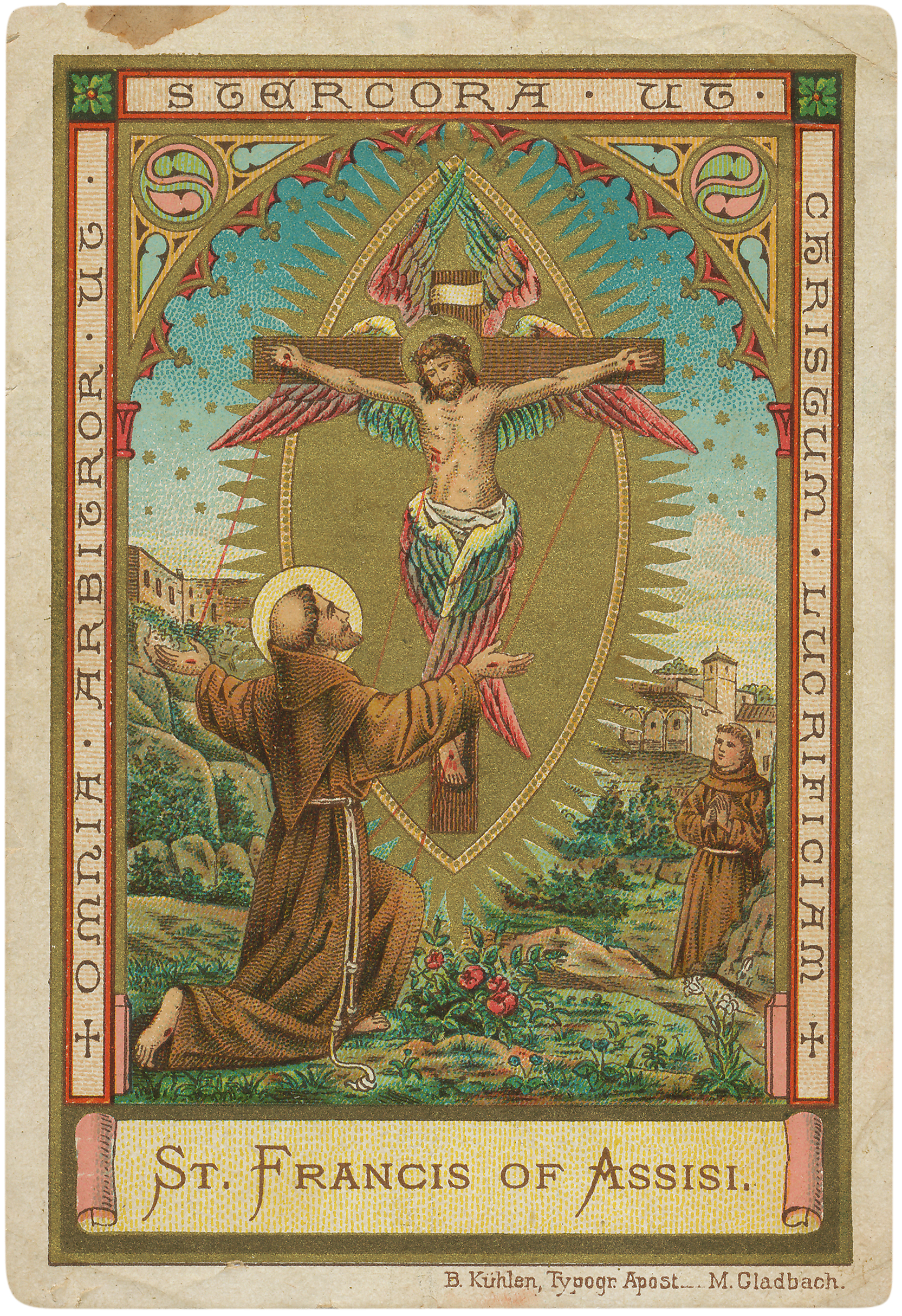
St.FrancisA great poet and mystic, Francis was the first saint to receive the stigmata
while in a meditative rapture. Filled with humility and though he founded one of the world’s greatest religious orders, Francis of Assisi was never ordained a priest. Upon his death he requested to be buried in the cemetery for criminals, but the people of Assisi so loved him that they took his body and interred it under the altar of their great cathedral.

Prayer

O Beloved Saint Francis, gentle and poor, your obedience to God, and your simple, deep love for all God’s creatures led you to the heights of heavenly perfection and turned many hearts to follow God’s will. Now in our day, in our ministry to the many who come here searching for peace and intercede for us we come before the Lord with our special requests…

(Mention your special intentions here.)

O Blessed Saint of God, from your throne among the hosts of heaven, present our petitions before our faithful Lord. May your prayers on our behalf be heard and may God grant us the grace to lead good and faithful lives. Amen

Saint Francis of Assisi, pray for us.

Everyday Miracles


IMG_0717Share them with us.

Here is one everyday miracle:

I went into a church to say some prayers before going to work on the weekend. I had taken my lunch in a plastic ziplock bag with me. I placed the bag next to me on the pew and closed my eyes and knelt. I was think about two things— I wished I had an extra $20.00 to donate to St. Anthony’s bread and the other that I had judged a friend mother who had recently died to harshly and I was asking for forgiveness. When Iopened my eyes and sat back down on the pew I found a $20.00 bill and folded sheets of paper cliped to my plastic lunch bag (the sheets had forgivenesss prayers on them). That is my everyday miracle.

Celebrating Mystic St. Francis of Assisi

St.FrancisA great poet and mystic, Francis was the first saint to receive the stigmata
while in a meditative rapture. Filled with humility and though he founded one of the world’s greatest religious orders, Francis of Assisi was never ordained a priest. Upon his death he requested to be buried in the cemetery for criminals, but the people of Assisi so loved him that they took his body and interred it under the altar of their great cathedral.

Prayer

O Beloved Saint Francis, gentle and poor, your obedience to God, and your simple, deep love for all God’s creatures led you to the heights of heavenly perfection and turned many hearts to follow God’s will. Now in our day, in our ministry to the many who come here searching for peace and intercede for us we come before the Lord with our special requests…

(Mention your special intentions here.)

O Blessed Saint of God, from your throne among the hosts of heaven, present our petitions before our faithful Lord. May your prayers on our behalf be heard and may God grant us the grace to lead good and faithful lives. Amen

Saint Francis of Assisi, pray for us.

Mystic: St. Theresa of Lisieux, 1873-1897

ST.THofLE

“I will spend my heaven doing good on earth.
After my death I will let fall a shower of roses.”

Therese Martin was the youngest of five daughters born to a very religious couple. At the age of four she lost her mother to breast cancer and the family moved from Normandy, France to the city of Lisieux to be among other relatives. Therese was spoiled by her older sisters and when the eldest joined the convent, she vowed to not only follow her, but to become a saint. She was admitted to the Carmelite cloister at the unusually young age of fifteen. Her sentimental fantasy of convent life was replaced by the reality of menial chores and constant prayer. She came face-to-face with her own doubts and weaknesses when she became ill with tuberculosis and her dream of doing missionary work in Hanoi was shattered Along with her diminished health, Therese had to accept the fact that she would never have the opportunity to travel the world and do great things. Feeling small and ineffectual, Therese went through a period of spiritual dryness where she doubted that her prayers were even heard.

By embracing her powerlessness, she was able to transform her life and develop her “Little Way”. A personal philosophy devoted to performing small, loving acts scattered throughout her day like so many flowers. Gradually, Therese realized that there were no actions that could be considered insignificant, no matter how small. If they were performed with love, they wouldhave great force.

In 1896, while she was bedridden, Therese was ordered to write her autobiography. This self examination is part of the Carmelite spiritual regime. After her death, the book called “The Story of A Soul” was published in a small printing. It soon became spectacularly successful, as ordinary men and women were able to easily identify with its author’s struggle to accept living a hidden, mundane life. It has been translated in at least 50 languages and Saint Therese has a very active and enthusiastic following all over the world.

The international influence of her book realized Therese’s dream to be a foreign missionary. Her Little Way is greatly influenced by the simplicity of children, so the concerns of children are one of her patronages. On her deathbed she vowed that “I will spend my heaven doing good on earth. After my death I will let fall a shower of roses.”

A sign that your novena to Saint Therese is being answered is the sight and smell of roses.

Novena to Saint Therese of the Child Jesus
O little Therese of the Child Jesus, Please pick for me a rose from the heavenly gardens and send it to me as a message of love. O little flower of Jesus, ask God today to grant favors I now place with confidence in your hands.

(Mention your request here).

Saint Therese, help me to always believe as you did, in God’s great love for me, So that I might imitate your “Little Way” each day.

Amen.

Holy People: St. Vincent de Paul, feast day September 27


St.VDEP“Go to the poor; you will find God.”
Vincent de Paul 1581-1660
Patron of: Abandoned Children, Charity, Orphans, Nurses, Slaves, Convicts, Prisoners.

Born into a peasant family in Gascony, France, Vincent de Paul was an exceptional student. Assigned by his order to attend to the spiritual needs of French royals, Vincent’s life as a priest would present him with vast contrasts. While on a journey he was unexpectedly taken prisoner by Turkish pirates and sold into slavery. When he converted one of his slave owners, he was released, and on his return to France, founded numerous charitable organizations dedicated to the needs of prisoners, orphans, and the poor. These organizations were the first of their kind and still thrive today. Because he improved the lives of so many of them, he is especially called on to protect children who have been abandoned by their families. Vincent de Paul was ordained a priest at the age of nineteen. Staying in Toulouse, he made a voyage to Marseille to claim an inheritance. Upon his return by sea, he was kidnapped by pirates and taken to Tunis. After being enslaved by three different owners, he returned to France in 1607 upon his last owner’s conversion. As a parish priest in Paris, he came in contact with some of the wealthiest and most influential families in France. In 17th century Europe, the poor, the orphaned and the abandoned were all considered of the same invisible class as convicts. Seeing the face of God in these forgotten people, he used his numerous connections with the upper classes to help tend to their needs. Vincent de Paul introduced a much needed concept of Christian compassion to society by forming the Daughters of Charity. This organization gave pious wealthy women a way of serving the poor. Financial donations poured in, and Vincent started “Servants of the Poor” and “Ladies of the Poor”, each charity devoted to either the sick, the orphaned, or the imprisoned.

Within a few years Vincent’s charities were started in other countries, Italy, Poland, Ireland, Scotland, the Hebrides, and Madagascar each had a mission. He never forgot or gave up on the lot of prisoners, and sent missionaries to ransom and spiritually tend those in Tunis and Algeria. He also dedicated much time and money to alleviating the suffering of convicts in France. Living during a time of religious wars, Vincent encouraged peace between Protestants and Catholics. Offering refuge to exiled Catholics from England and Ireland, he also ordered his missionaries in the French countryside to respect and help out any needy Protestants. Though he was frequently welcomed by the King and Queen of France, his first devotion was to the poor and he used his royal audiences to obtain state funds for his many missions and hospitals. Vincent de Paul worked tirelessly until his death and it is said that he did more than any other person to relieve the burden of the poor in the seventeenth century.

Novena

God you were patient with St. Vincent de Paul as you moved him from
self-centeredness to be centered on you. Help me through his intercession
to grant me this petition and to know that you will grant what I desire in
your own time (your intention here) . I thank you God for everything and I
will imitate St. Vincent de Paul in growing in holiness through prayer,
participation in the sacraments and service to my neighbor especially the
poor.
Amen.

Angel: St. Michael

St.Michael_symbols copy

According to the Book of Revelations, Michael was the angel who rose to God’s defense when Lucifer, God’s favorite and most beautiful angel decided that he was God’s equal. Leading a band of renegade angels he made an attempt to take over the throne of heaven. One outraged angel shouted, “Who is like God?” (mi-cha-el) and struck down Lucifer and his group, casting them into hell for their vanity. This angel took the name Michael as a reminder of his loyalty. A popular figure to the ancient Jews, early, Christians and Muslims, he is closely tied to the history of mankind and serves as its guardian.

Michael’s role in the world is firmly mandated: 1) He is to fight against Lucifer, no matter where he might be. 2) He is to rescue the souls of the faithful from the power of evil, especially at the time of death. 3) He is the champion of God and the protector of the Church. 4) He brings souls to justice, weighing the souls of the dead and deciding on who gets into heaven and who gets into hell.

Since Michael was the one who threw Lucifer into hell, Lucifer and the denizens of hell have no power over him. Catholics believe that Michael and the Virgin Mary are the only beings besides Jesus who can go into hell and release souls who are suffering there. Because of their actions in the great battle of heaven, it is Lucifer’s fate to reside in the lowest netherworld and it is Michael’s to dwell nearest to heaven. His shrines are the most ancient and natural in Christendom and tend to be on high, inaccessible cliffs that only a celestial being could reach. The Gargano caves in Apulia, Italy are said to be the first earthly dwelling place for the archangel. They have been an immensely popular pilgrimage site since the year 490 AD.

Saint Michael the Archangel is considered the most powerful of all angels. Christians in the East see him as a great healer, crediting him with the creation of many healing springs. In the sixth century, as Rome was being devastated by a plague, Pope Gregory I saw the archangel hovering over the tomb of the Emperor Hadrian, brandishing his sword. He interpreted this to mean that Rome was under the archangel’s protection and the plague would soon cease. A church was built over the tomb still bearing the title Castel San Angelo in honor of Michael.
Immensely popular throughout the world, Michael is always shown brandishing a sword while standing on the neck of the devil (sometimes interpreted as a giant serpent). In many images he holds the scales that will weigh the souls of the dead, because of this he is the patron saint of greengrocers who use these scales.

Mother of Sorrows Meditations

Sorrows copy

Mother of Sorrows
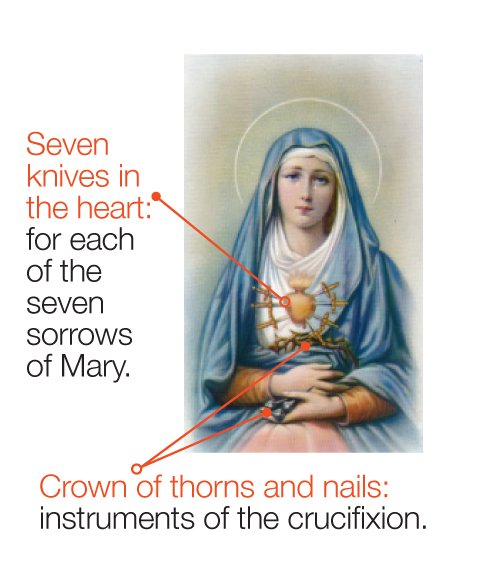
When we are overwhelmed with grief, we turn to Mary, Mother of Jesus for help in our suffering. Throughout her life she endured much pain and sorrow and is fully able to empathize with anyone’s personal anguish. She endured the shame of being pregnant and unmarried, being poor, homelessness and having her only son unjustly imprisoned and executed. Most astonishing, Mary knew what was to befall her son yet had to see these events from God’s point of view and have faith that this was all for the good of mankind.

By meditating on the Seven Sorrows of Mary, a devotion from the Middle Ages, which uses scenes from the life of the Virgin Mother as a meditation on accepting the sorrowful part of life with grace.

The Seven Sorrows of Mary are:

1) The Prophecy of Simeon. As a young child, when his parents presented him in the temple, Jesus was met by the holy man Simeon who predicted everything that would happen to him in his address to Mary: “Behold, this child is destined for the fall and rise of many in Israel, and to be a sign that will be contradicted – and you yourself a sword will pierce so that thoughts of many hearts will be revealed.” (Luke 2:34-35).

2) The Flight into Egypt. In Bethlehem, after the birth of Christ, Joseph had a vision of an angel warning him of the impending slaughter of any male child under the age of two by King Herod in order to prevent the coming Messiah. The Holy Family had to travel a secretive route to Egypt and remain in that country until Herod died. Mary not only worried for the welfare of her own son but mourn for the murdered children left behind.

3) The Loss of the Child Jesus in the Temple. While on a pilgrimage to Jerusalem, the 12 year old Jesus vanished from his family. His heartsick parents finally found him three days later, arguing with elders in the temple.

4) The Meeting of Jesus with His Cross. Mary watched helplessly as her son was ridiculed and mocked as he stumbled, carrying the cross he was to be executed on.

5) The Crucifixion. As he was nailed to the cross, most of his disciples ran away. Mary never wavered as she stood at the foot of the cross, witnessing her son’s agony and death.

6) Jesus Taken Down from the Cross. Mary held her dead son’s wound covered body. This, her greatest sorrow is known as the “Pieta”.

7) The Burial of Jesus. As the stone was rolled, closing up his tomb, Mary had to say her final goodbye to her earthly son. Her faith had to be sincerely tested as there was no hint of the resurrection to come.

St. Thomas Aquinas

St.Thomas

St. Thomas Aquinas 1225-1274
Patron of: Students, Education, Universities, Schools, Catholic Schools, Thunderstorms, Lightning, Sudden Death, Booksellers, Theologians, Pencil Makers, Chastity, Learning.

Historians regard St. Thomas Aquinas as one of the greatest philosophers of the Middle Ages. Yet on his deathbed, this intensely popular teacher and lecturer, who had lived in the cosmopolitan environments of Paris, Cologne and Naples, was said to give the innocent final confession of a child. Known in his lifetime as “The Angelic Doctor”, Thomas lived through his higher mind, taking intense pleasure in intellectual pursuits. Because he was an excellent teacher, able to clarify the most complicated points of learning, Thomas Aquinas is invoked by students whenever they are presented with a challenging test, a demanding course of studies or difficulty in passing an entrance exam.

Thomas was born in his noble family’s castle just outside of Naples, the youngest of four brothers and two sisters. As a child, one of his sisters was killed by lightning while sleeping in the same room as Thomas. He was forever fearful of thunderstorms, he is invoked by those with the same fears for protection against lightning strikes and sudden death. At the age of five Thomas was sent to study to the legendary Monastery of Monte Cassino. Considered the seat of Western Civilization through the dark ages, all manners of the arts and sciences were taught there. By the time Thomas left at the age of thirteen to attend the University of Naples, he was already tutoring his elders in their studies. While a student in Naples he horrified his noble family by joining the new order of mendicant Friars known as the Dominicans. Instead of begging in the streets with the Dominicans, his parents wanted to see Thomas using his great intellectual gifts to earn a higher ecclesiastical office. His brothers kidnapped him and locked him up in another family home, tempting him with every worldly thing they could think of. When they presented him with a prostitute, Thomas chased her out with a burning brand from the fireplace.
After two years of confinement, his family relented and freed him The Dominicans sent Thomas to Cologne, Germany to study with Albert the Great, the most famous teacher of his times. Because of his quiet, kindly manner and his large size, his fellow students labeled him “the dumb ox”. Thomas quietly surpassed every student he ever had and Albert insisted he go to the University of Paris where he was made a teacher and received a doctor’s chair. His writings attracted both the Pope and the King of France who consulted him on matters of state. In 1272, the Dominicans sent him to Naples to run their school there. It was during the following year that experienced an ecstasy that caused him to suddenly stopped writing his greatest work , Summa Theologica, a tome that consisted of over two million words and he had spent the last seven years on. Compared to his vision, he declared, “all that I have written seems like so much straw.”

Prayer

Saint Thomas Aquinas, patron of students and schools, I thank God for the gifts of light and knowledge God bestowed on you, which you used to build up the church in love. I thank God, too, for the wealth and richness of theological teaching you left in your writings. Not only were you a great teacher, you lived a life of virtue and you made holiness the desire of your heart. If I cannot imitate you in the brilliance of your academic pursuits, I can follow you in the humility and charity that marked your life. As Saint Paul said, charity is the greatest gift, and is open to all. Pray for me that I may grow in holiness hand charity. Pray also for Catholic schools and for all students. In particular, please obtain the favor I ask during this novena. (Mention your request). Amen.

Angels: St. Raphael

St. Raphael Archangele*
St. Raphael the Archangel
Patron of: Travelers, Happy Meetings, To Meet A Life Partner, Blind, The Sciences. Scientific Discovery, Healing, Joy, Consolation, Eye Troubles, Oculists, Guidance.

Of all the seven archangels who sit at the throne of God, Raphael is known as the angel of everyday life. While Michael and Gabriel influence whole nations and predict coming world events and dramatic changes, Raphael accompanies us in our personal daily actions. We pray to him before we take a trip, whenever we are ill or for help in meeting a life partner. The name Raphael means “God heals” and it is said that this was the angel who controlled the healing waters of Probatica, a pond, in ancient times, where desperately ill people would go and wait for the angel to move the waters over them, effecting their healing.
Raphael’s iconography and characteristics are best illustrated by the story in the scriptural Book of Tobit. When Tobit was struck blind he became unable to accompany his son Tobias on a trip across the desert to collect money he had left in the town of Media. He prayed to the archangel for a solution and Raphael appeared to Tobias as a man named Azariah. At the same time, a woman name Sara was invoking the archangel for help in expelling a demon that had killed each one of her seven husbands on their wedding night. The archangel disguised as Azariah made a joyful and happy traveling companion, successfully guiding Tobias and his dog on the long journey. When Tobias and the angel reached the other side of the desert they saw Sara and the archangel insisted that she would make a perfect wife for Tobias. In order to defeat the demon that was plaguing her, he had Tobias catch a large fish, burn the innards and drive out the demon on his wedding night. This resulted in a long and happy marriage for both of them. When Raphael revealed his true identity to Tobias, he ordered him to take the gall from the fish back to his father and heal his eyes with this. In this way, he was able to answer the prayers of the disparate group that petitioned him, bringing a much happier outcome than any one of them would have imagined. He healed a blind man, guided Tobias on his journey, and influenced the happy meeting and joyous marriage between Tobias and Sara.

Raphael is also credited with helping mankind develop scientific knowledge. He helped Noah build his ark and instructed King Solomon on building the great temple of Jerusalem. Intimately involved in the smallest nuance of daily life, he not only delivers us on a safe journey, but also guides us on a more enlightened one.

Prayer

Glorious archangel Saint Raphael, great prince of the heavenly court, you are illustrious for your gifts of wisdom and grace. You are a guide of those who journey by land or sea or air, consoler of the afflicted, and refuge of sinners.

I beg you, assist me in all my needs and in all the sufferings of this life, as you once helped the young Tobias on his travels. Because you are the “medicine of God”, I humbly pray you to heal the many infirmities of my soul and the ills that afflict my body. I especially ask of you the favor (your intention here) and the great grace of purity to prepare me to be the temple of the Holy Spirit.
Amen.

Mystic


Padre-Pio-young

Padre Pio 1887-1968
Patron of: Forgiveness, Healing, Miracles, Reconciliation.

Denounced by Vatican officials as a fraud, and his mystical gifts frequently viewed with suspicion by his immediate superiors, Pio of Pietracelina was sequestered away in the remote monastery of San Giovanni Rotondo where it was expected that he would labor as a monk in obscurity. His adeptness in both physical and spiritual healing and his ability to read hearts and minds while in confession made him wildly popular among the common people of that impoverished region of Italy. Today, the town of San Giovanni Rotondo is the second most visited place by religious pilgrims who venture there to pay homage to one of the most popular saints of the twentieth century, Padre Pio. Made a saint in 2002, Padre Pio has no official patronage. Because of his devotion to the powers of the Sacred Heart of Jesus and his own suffering due to the mistrust of his superiors, he is frequently invoked to bring the grace of forgiveness to a situation.

Born Francesco Forlione in Pietracelina, a town north of Naples, he was named for his patron saint, Francis of Assisi. Coming from a religious family, he said he had spiritual visions of Christ and the Virgin Mary from a very young age. He never mentioned them to anyone as he assumed all people had such gifts. He was ordained as a Capuchin friar in 1910 taking the name Pio (meaning “Pious”) but was sent home due to a diagnosis of tuberculosis. While convalescing he offered himself as a conduit of suffering in exchange for the salvation of others. Eventually, in 1916 he was conscripted into the army where he contracted such a high fever that he was sent home to die. Upon his miraculous recovery from this illness, the Capuchin order sent him to the very remote monastery of Our Lady of Grace in San Giovanni Rotondo in Puglia, a province of Southern Italy. On September 20, 1918, while praying in the stillness of the church, Pio went into a trancelike state where he saw Christ standing before him bleeding from the wounds of the crucifixion. Pio’s heart almost burst in sympathy before coming out of the state in intense pain. Upon regaining consciousness he found himself to be afflicted with the same wounds of the crucifixion. It was this condition which only ended at his death in 1968, which would bring him under intense scrutiny by church officials for the rest of his life.

Pio’s talents for deciphering what people meant to tell him during confession but were too embarrassed or ashamed to bring up, became immediate apparent to the local townspeople and he developed a great following among them. They credited him with an incredible capacity of healing, mending physical ills, familial squabbles, and curing spiritual desolation. When Vatican Officials severely limited his official duties, the one mass he was allowed to say at 5 AM, had thousands lining up the night before so that they may be with him. Without ever leaving the monastery, he was known as “the living saint” as he sighted in hospitals and at sickbeds hundreds of miles away. The onset of World War Two spread his cult on an international level as soldiers from Australia, other parts of Europe, and the United States witnessed his miraculous abilities. By the late 1940’s he was receiving hundreds of international prayer requests per day.

He eventually founded a hospital for the hopelessly ill, the internationally acclaimed House for the Relief of Suffering, which treats tens of thousands of people each year and survives solely on charitable donations.

The animosity that many Vatican officials had against Padre Pio was dissolved in 2002 when Pope John Paul II declared him a saint. This pope knew Pio’s powers firsthand as he had visited him fifty years before as a young seminarian in the hopes of obtaining a cure for a friend. Not only did his friend’s cancer go into remission, but Pio’s strange prediction of this obscure Polish priest’s rise to pope also came true.

It is important to note that Padre Pio himself recited the Novena to the Sacred Heart of Jesus for the intentions of those who requested his prayers every day.

Novena

Dear God, Thou hast generously blessed Thy servant, St. Pio of Pietrelcina, with the gifts of the Spirit. Thou hast marked his body with the five wounds of Christ Crucified, as a powerful witness to the saving Passion and Death of Thy Son. Endowed with the gift of discernment, St. Pio labored endlessly in the confessional for the salvation of souls. With reverence and intense devotion in the celebration of Mass, he invited countless men and women to a greater union with Jesus Christ in the Sacrament of the Holy Eucharist.

Through the intercession of St. Pio of Pietrelcina, I confidently beseech Thee to grant me the grace of (mention your intentions here). Amen.

Recite three Glorias.